

Application Layer
The application layer is the part of your system that executes business logic: it receives a request, validates input, orchestrates calls to databases and downstream services, applies the rules that make your product meaningful, and returns a response. In a well-designed service, application servers are stateless — they hold logic and orchestration, while state lives in dedicated stores (databases, caches, object storage).
How it works
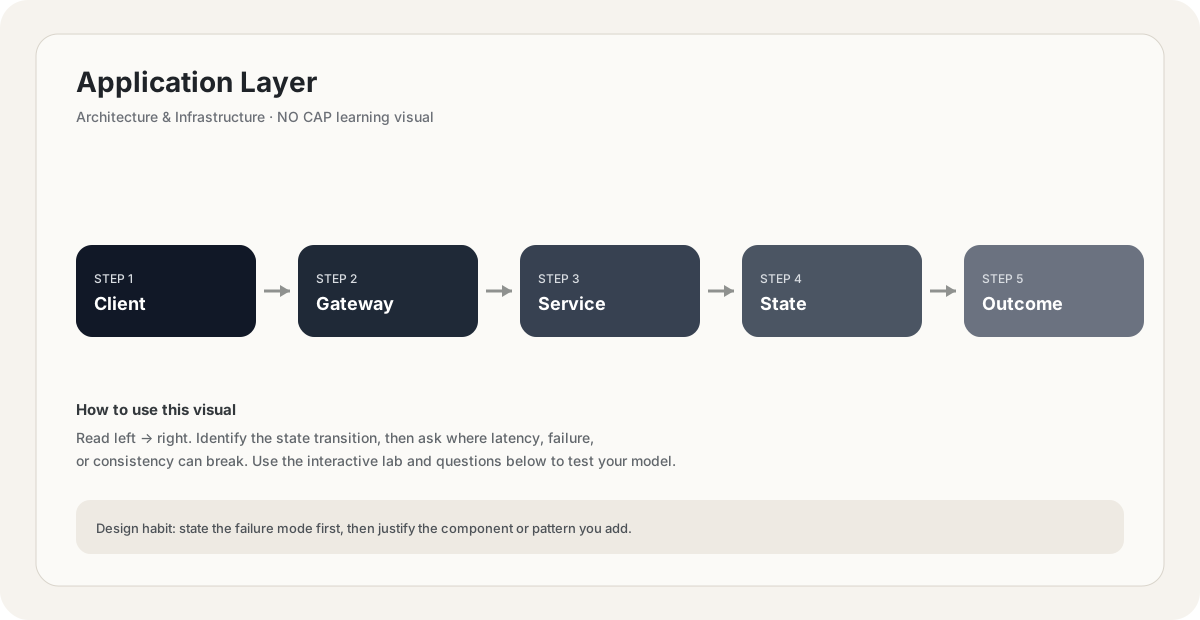
When a client sends an HTTP request to your service, it travels through DNS, a load balancer, maybe a reverse proxy, and finally arrives at the application layer. There, a handler decides what to do: parse the request, authorize the caller, run business rules, talk to a database or cache, and shape a response.
The application layer is the logic-and-orchestration tier. It does not own the data (the database does). It does not own delivery (the load balancer and CDN do). It owns the rules: 'a user may not transfer more than their balance', 'an order in shipped state cannot be cancelled', 'a premium subscriber gets 1 TB of storage instead of 5 GB'. Those rules are the product, expressed as code.
Two properties define a well-built application layer: it is stateless (no per-request state survives the response), and it is ephemeral (any instance can be killed and replaced at any time without losing data).
Where state lives vs where logic lives
A reliable rule: if a process restart would lose information that the user cares about, that information is in the wrong place. Push it into a store.
| Kind of state | Wrong place | Right place |
|---|---|---|
| User session | In-memory req.session on app server | Redis or signed JWT |
| In-progress file upload | /tmp on app server | Object storage (S3) with multipart upload |
| Recently-viewed items | Local LRU cache | Redis with a TTL |
| Computed report | Local file | Object storage or shared filesystem |
| Counter / rate limiter | Process-local int | Redis with INCR + expiry |
| Workflow state | In-process variable | Database row or workflow engine (Temporal) |
Application-layer logic that needs state always asks a backing store. The app tier can cache aggressively (to reduce load on the store), but the cache is never the source of truth. If the cache is lost, the next request simply re-reads from the store.
What statelessness buys you:
- Horizontal scaling — add more instances; the load balancer fans traffic out. No need to migrate or shard sessions.
- Rolling deploys — drain one instance (stop sending new requests), let in-flight ones finish, deploy, re-add. Repeat. Zero downtime.
- Auto-scaling — if CPU exceeds 70%, autoscaler adds instances. They become useful immediately because they have no warmup state to acquire.
- Failure tolerance — an instance crash loses nothing the user cares about. The LB routes around it.
- A/B testing and gradual rollouts — a different code version on 5% of instances routes 5% of traffic.
Stateful app servers break all of these. Sticky sessions (the 'fix' for in-memory state) pin a user to one instance; if that instance dies, the user is logged out. Worse, you cannot freely scale because new instances have no sessions.
A few cases legitimately keep state in the application process: WebSocket connections (long-lived, tied to one process — must be coordinated via pub/sub for horizontal scaling), in-process caches that are explicitly expendable (a CDN-like LRU in front of Redis), and local state for a single request (parsed JWT, request-scoped context). The test is: if this process died, would the user notice anything other than a brief retry? If yes, the state is in the wrong place.
Inside the application layer:
Even a 'monolithic' application server benefits from internal layering. A common split:
- Transport / handler — receives HTTP, parses request, returns response. Should contain no business logic. Examples: Express routes, Django views, Spring
@RestController. - Service / use-case — the actual business rules. 'CreateOrder', 'ChargeCard', 'SendWelcomeEmail'. Pure functions of input + state, no HTTP awareness.
- Repository / data access — talks to the database. Translates between domain objects and storage rows.
- Domain model — entities and value objects that capture the rules of the business (an
Orderknows its valid transitions).
This is sometimes called hexagonal or ports-and-adapters architecture. The payoff: the business rules are testable without HTTP, and you can swap the database or framework without rewriting logic. Most production codebases drift away from this ideal, but the direction matters — keep transport concerns out of the service layer.
Your team stores user sessions in process-local memory. After deploying behind a round-robin load balancer, users report being logged out constantly. What is the correct fix?
Pick one answer.
Which of the following is a sign that state is leaking into the wrong layer?
Pick one answer.
Why is the boundary between transport/handler code and service/use-case code worth maintaining, even in a small application?
Pick one answer.
Engineering mental model
Mental model. Think of Application Layer as a deliberate boundary in a system. The boundary exists because something becomes harder to manage when everything is done in one place: latency, scale, failure isolation, consistency, cost, or team ownership. The useful question is not “what does Application Layer mean?” but “what pressure makes this boundary worth introducing, and what new failure mode does it create?”
Before choosing Application Layer, name the workload, the critical user path, the dominant bottleneck, the failure you are trying to absorb, and the trade-off you are willing to accept. If you cannot name those five things, the design is probably premature.
// Pseudocode
request = receive()
result = application_layer(request)
return result

// Production questions:
// 1. What happens on timeout?
// 2. Can this operation be retried safely?
// 3. What is the bottleneck?Back-of-the-envelope reasoning
Numerical lens: write down traffic, payload size, read/write ratio, peak multiplier and durability target before choosing a component. The numbers should justify the architecture.
If you are stuck on Application Layer, start by drawing the request path and marking every network hop, stateful component, queue, cache and failure boundary. Then estimate where the system will saturate.
You increase traffic by 10× in a system using Application Layer. What should you inspect first?
Pick one answer.
Which statement is the safest engineering habit when using Application Layer?
Pick one answer.
You have dashboards for traffic, latency, errors and saturation. You can change the architecture, but every change has operational cost.
Production scenario: your system uses Application Layer, traffic suddenly spikes, and p99 latency doubles. What is your first move?
Interview drill
Answer this without notes: When would you choose Application Layer, and when would you intentionally avoid it? Mention at least one bottleneck it addresses, one failure mode it introduces, and one alternative. Then quantify the workload you are designing for.
A useful engineering lens for Application Layer: define the problem it solves, the simpler design that fails first, the constraint that forces you to introduce this concept, and the new failure modes the concept creates.
Numerical sanity check
Back-of-the-envelope reasoning beats fake precision. State your traffic, payload, concurrency and growth assumptions explicitly, then calculate enough to know whether the current architecture is orders of magnitude away from the target.
Do not optimize for a memorized definition. Reason from the workload and failure mode.
Imagine the simplest version of a system using Application Layer. What breaks first as traffic grows by 10×, and what would you change before reaching 100×?
Pick one answer.
Interactive sandbox: Application Layer
App-layer cost = business logic × DB calls. Predict total per-request latency for Application Layer.
Change one variable at a time. Predict the failure mode first, then move the slider and see whether your mental model matches the simplified system response.
What you gain, what you pay
- +Stateless app servers enable horizontal scaling, rolling deploys, and auto-scaling.
- +Clear separation of logic and state makes systems testable and reasoning about failures simpler.
- +Any instance can serve any request — no sticky sessions, no affinity headaches.
- +Internal layering (handler / service / repository) keeps business rules independent of delivery mechanism.
- −Pushing state to a shared store adds a network hop and a dependency on that store's availability.
- −Strict layering requires discipline; shortcuts (e.g., DB queries inside a controller) are always tempting.
- −Pure statelessness is sometimes impossible (WebSockets, long polling) and requires careful coordination.
- −More moving parts: caches, queues, and session stores that would not exist if the app held state.
How this breaks in production
- In-memory session state that pins users to instances and breaks failover.
- Local file uploads lost when an instance crashes before being streamed to object storage.
- Local-only caches that silently diverge across instances, causing inconsistent behavior.
- Business logic scattered across handlers, services, and even SQL — making rule changes risky.
- Instance 'warmup' dependencies (e.g., preloaded config) that cause new instances to be briefly broken.
Don't fall into these traps
- •Treating the app server as a safe place to keep state. It is not — it is the most volatile tier.
- •Using sticky sessions as a fix for in-memory sessions instead of moving sessions to Redis.
- •Putting business rules inside HTTP handlers, coupling them to the transport.
- •Caching in-process and forgetting it is not shared — different instances see different data.
- •Mixing orchestration (calling downstream services) with business rules, so unit tests must mock HTTP.
Real systems using this
How real systems implement this
- Stripe API — Stripe's API servers are stateless and horizontally scaled; every charge, customer, and refund lives in durable stores (databases and event logs). Any instance can serve any request, which is why rolling deploys and rapid feature shipping are possible without downtime.
- Netflix API (BFF pattern) — Netflix runs device-specific Backend-for-Frontend services — each BFF is a stateless application layer that aggregates calls to dozens of downstream microservices and shapes the response for one client (TV, mobile, web). The BFF holds logic and orchestration; state lives in the downstream services.
- AWS Lambda — Lambda forces statelessness: function instances are ephemeral and may be killed between invocations. Any state must live in S3, DynamoDB, or other managed stores — a design constraint that has trained a generation of developers to keep logic and state apart.
Practice saying it out loud
- Q1Why should application servers be stateless? What breaks if they are not?
- Q2Where does each of these belong: user sessions, file uploads, recently-viewed items, in-flight workflow state?
- Q3Your service uses WebSockets for real-time updates. How do you keep the application tier stateless while still serving long-lived connections?
- Q4Walk me through the layers inside a well-structured application server. Why separate handler, service, and repository?
- Q5What are the operational benefits of statelessness — specifically for deploys, scaling, and failure?
Further reading & references
Core explanations are original NO CAP material. External references are provided for deeper study and standards.
What next?
Mark as understood once the mental model clicks.
Next recommended
Microservices