

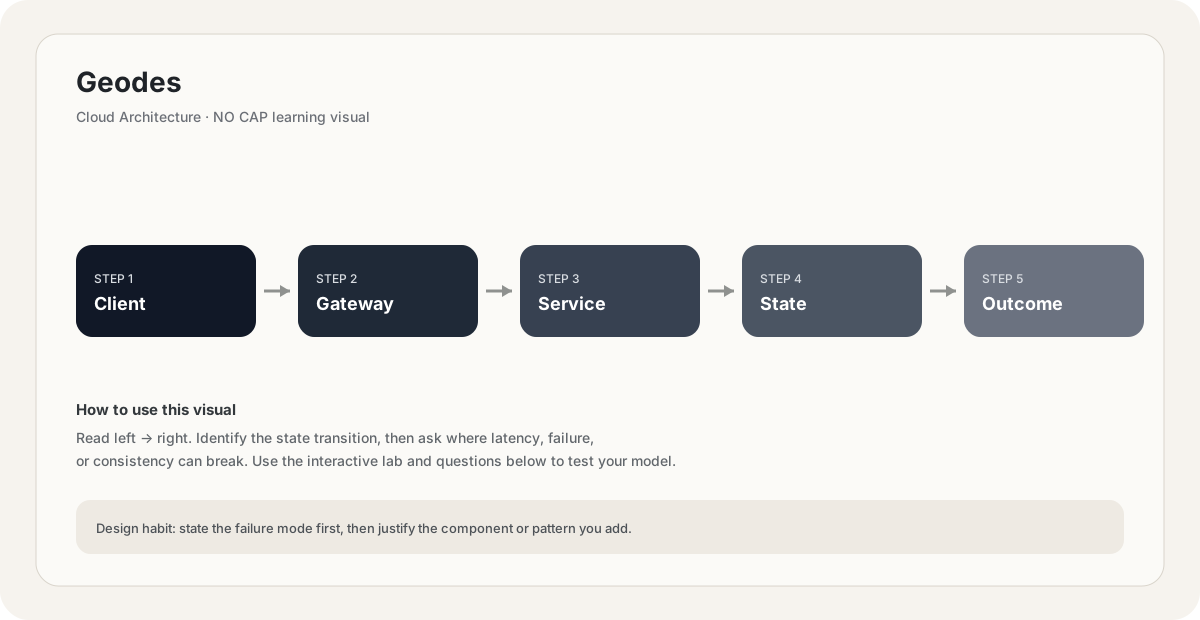
Geodes
The Geodes pattern deploys backends in multiple geographically distributed regions, all active simultaneously, with users routed to the nearest one. Unlike active-passive multi-region (where one region handles traffic and the other stands by), Geodes is active-active: every region serves users, every region has a full copy of the data, and a region failure just shifts its users to another region. The pattern gives low latency to global users, survives region outages, and scales linearly with the number of regions — at the cost of data replication complexity.
Foundational.
How it works
The Geodes pattern, named after polyhedral structures that tile a sphere (like a geodesic dome), is the cloud-architecture pattern for globally distributed active-active backends. The name evokes the idea of tiling the planet with deployment regions, each serving nearby users.
Key properties:
- Multiple regions, all active — every region serves live user traffic. No stand-by regions waiting for failover.
- Full stack in each region — application, database, cache, queues. Each region is self-sufficient.
- Data replication across regions — writes in one region propagate to others. This is the hard part.
- User routing — a global routing layer (DNS, anycast, latency-based routing) directs each user to the nearest active region.
- Region failure is graceful — if a region dies, its users are redirected to other regions.
The routing layer is usually:
- Latency-based DNS (Route 53 latency routing, Cloudflare load balancer) — picks the region with lowest latency to the user.
- Anycast — the same IP is advertised from multiple regions; BGP routing sends the user to the nearest.
- Geo-DNS — explicit geographic mapping (EU users go to EU regions).
- HTTP redirect — a global front service redirects to a region-specific URL.
The critical challenge is data replication:
- Writes must propagate between regions for the system to be globally consistent.
- Replication latency introduces a window where two regions disagree.
- Conflict resolution is required when two regions accept writes to the same data simultaneously.
Replication strategies:
- Async multi-master — each region accepts writes locally and replicates asynchronously. Eventually consistent. Conflicts possible.
- Sync multi-master — writes are replicated synchronously before acknowledgement. Strong consistency but high write latency (cross-region round-trip).
- Single writer (leader) — one region is the leader for writes; others are read replicas. Simpler consistency but write latency for non-leader regions.
- Per-partition leaders — each partition has its own leader region (DynamoDB Global Tables, Spanner). Distributes write load.
- CRDTs / last-writer-wins — application-level conflict resolution. Works for some data (counters, sets), not all.
Data replication is the crux of Geodes. Three models, each with trade-offs:
1. Asynchronous multi-master (eventual consistency) — each region accepts writes locally, replicates async. Lowest write latency, but conflicts possible. Used by: DynamoDB Global Tables, Cassandra multi-region, CouchDB. Resolution: last-writer-wins, CRDTs, or application-level merge. Suitable for: counters, content (posts, comments), state where brief inconsistency is acceptable. Not suitable for: financial transactions, inventory, anything requiring strong consistency.
2. Synchronous multi-master (strong consistency) — writes are committed across all regions before acknowledgement. Strong consistency, but write latency = cross-region round-trip (~100-300ms). Used by: Spanner, CockroachDB, FoundationDB. Suitable for: financial systems, anything requiring linearizability. Trade-off: write latency, throughput limits, complexity.
3. Single leader (leader-follower) — one region is the leader for writes; others are read replicas. Writes go to the leader (high latency for non-leader regions), reads go to the local replica (low latency everywhere). Used by: Postgres with logical replication, Aurora Global Database, MongoDB replica sets. Trade-off: write latency for non-leader regions; leader is a SPOF (needs failover).
4. Per-partition leaders — each partition has its own leader; different partitions can be led by different regions. Distributes write load. Used by: Spanner, DynamoDB Global Tables (with per-key leaders), Cassandra. Combines low write latency for most partitions with strong consistency.
Conflict resolution is the hard problem when async multi-master is used:
- Last-writer-wins — simple but lossy; the losing write is silently overwritten.
- Vector clocks / version vectors — detect concurrent writes; application resolves.
- CRDTs (Conflict-free Replicated Data Types) — data structures that merge deterministically; counters, sets, maps. Used by: Riak, Redis CRDT, AntidoteDB.
- Application-level merge — the application knows how to combine two versions (e.g., a shopping cart merges items).
- Avoid conflicts by design — partition writes by user/tenant so each user only writes in one region at a time. Most practical systems do this.
Geodes and Deployment Stamps both deploy multiple independent copies of a system, but for different reasons. Deployment Stamps partitions users for blast-radius isolation and scale-out — stamps are often in the same region. Geodes deploys copies in different regions for geographic latency and region-failure resilience. The two combine: each region's deployment is itself a stamp, with stamp-routing layered on top of region-routing. A user might be assigned to ‘us-east stamp 3’ for both geographic and blast-radius reasons.
When to use Geodes:
- Global user base with latency expectations — users in Asia shouldn't wait 200ms to reach a us-east-1 backend.
- Region failure is unacceptable — SLAs require surviving a region outage without user impact.
- Data residency requirements — EU users' data must stay in EU; Geodes lets you keep each region's data local.
- Read-heavy workloads — reads can be served from any region; Geodes works well for read-heavy traffic.
- Linear scale with regions — adding a region adds capacity linearly.
When NOT to use Geodes:
- Single-region user base — if all your users are in one country, multi-region adds cost without benefit.
- Strong consistency required everywhere — sync multi-master is expensive; sync leader writes have high latency for non-leader regions.
- Write-heavy workload — writes are the hard problem; sync writes are slow, async writes risk conflicts.
- Small team — operating multi-region active-active is complex and expensive. Most teams shouldn't.
- Cost-sensitive — running multiple full stacks doubles or triples the bill.
Common operational concerns:
- Routing layer is a critical SPOF — must be HA, multi-region, with DNS-level failover (Route 53, Cloudflare).
- Per-region monitoring — each region needs its own dashboards, alerts, on-call rotation.
- Region failover — when a region dies, its traffic shifts to others. The other regions must have headroom to absorb the extra load.
- Replication lag monitoring — if lag grows, regions drift; user-visible inconsistency grows.
- Testing failover — must be exercised regularly (GameDays, chaos engineering) to ensure it works when needed.
What is the key difference between Geodes and active-passive multi-region?
Pick one answer.
Two users, one in Tokyo and one in New York, simultaneously update the same record. With async multi-master replication in a Geodes deployment, what happens?
Pick one answer.
Engineering mental model
Mental model. Think of Geodes as a deliberate boundary in a system. The boundary exists because something becomes harder to manage when everything is done in one place: latency, scale, failure isolation, consistency, cost, or team ownership. The useful question is not “what does Geodes mean?” but “what pressure makes this boundary worth introducing, and what new failure mode does it create?”
Before choosing Geodes, name the workload, the critical user path, the dominant bottleneck, the failure you are trying to absorb, and the trade-off you are willing to accept. If you cannot name those five things, the design is probably premature.
// Pseudocode
request = receive()
result = geodes(request)
return result

// Production questions:
// 1. What happens on timeout?
// 2. Can this operation be retried safely?
// 3. What is the bottleneck?Back-of-the-envelope reasoning
Numerical lens: write down traffic, payload size, read/write ratio, peak multiplier and durability target before choosing a component. The numbers should justify the architecture.
Interactive sandbox: Geodes
Geodes run independent deployments per region. Predict sync overhead for Geodes.
Change one variable at a time. Predict the failure mode first, then move the slider and see whether your mental model matches the simplified system response.
If you are stuck on Geodes, start by drawing the request path and marking every network hop, stateful component, queue, cache and failure boundary. Then estimate where the system will saturate.
You increase traffic by 10× in a system using Geodes. What should you inspect first?
Pick one answer.
Which statement is the safest engineering habit when using Geodes?
Pick one answer.
You have dashboards for traffic, latency, errors and saturation. You can change the architecture, but every change has operational cost.
Production scenario: your system uses Geodes, traffic suddenly spikes, and p99 latency doubles. What is your first move?
Interview drill
Answer this without notes: When would you choose Geodes, and when would you intentionally avoid it? Mention at least one bottleneck it addresses, one failure mode it introduces, and one alternative. Then quantify the workload you are designing for.
A useful engineering lens for Geodes: define the problem it solves, the simpler design that fails first, the constraint that forces you to introduce this concept, and the new failure modes the concept creates.
Numerical sanity check
Back-of-the-envelope reasoning beats fake precision. State your traffic, payload, concurrency and growth assumptions explicitly, then calculate enough to know whether the current architecture is orders of magnitude away from the target.
Do not optimize for a memorized definition. Reason from the workload and failure mode.
Imagine the simplest version of a system using Geodes. What breaks first as traffic grows by 10×, and what would you change before reaching 100×?
Pick one answer.
What you gain, what you pay
- +Low latency for global users — every user served by a nearby region.
- +Survives region outages — users shift to other active regions.
- +Read-heavy workloads scale linearly with regions.
- +Data residency compliance — each region's data stays local.
- +No wasted standby capacity — every region is productive.
- −Data replication is complex — sync (high write latency) or async (conflict resolution).
- −Cost — running N full stacks multiplies the bill.
- −Operational complexity — per-region monitoring, failover testing, replication lag tracking.
- −Routing layer is a critical SPOF — must be HA, multi-region itself.
- −Cross-region consistency is hard — eventual consistency may surprise users.
How this breaks in production
- Replication lag grows — regions drift; users see inconsistent state across regions.
- Routing layer failure — directs users to wrong region or no region; needs HA and DNS failover.
- Region failover overwhelm — other regions lack headroom to absorb the failed region's traffic.
- Conflict resolution bugs — bad merge logic silently loses or corrupts data.
- Split-brain — a network partition makes regions think they're each the leader.
- Cross-region dependency — a service in region A synchronously calls a service in region B, defeating the latency benefit.
Don't fall into these traps
- •Using async multi-master without thinking through conflict resolution — silent data loss.
- •Allowing synchronous cross-region calls in the request path — kills latency benefit.
- •Not testing region failover regularly — untested failover is no failover.
- •Not monitoring replication lag — silent drift causes user-visible bugs.
- •Underestimating operational cost — running N regions is N× the operations work.
- •Single routing layer SPOF — must be HA, multi-region, with DNS-level failover.
Real systems using this
How real systems implement this
- DynamoDB Global Tables — AWS's managed multi-region active-active NoSQL database. Each region accepts reads and writes; changes are replicated asynchronously to other regions within seconds. Conflict resolution is last-writer-wins by default. Used by customers needing low-latency global access without operating their own replication.
- Cloudflare Anycast Network — Cloudflare's global edge network uses anycast routing — the same IP is advertised from hundreds of PoPs. User traffic is routed to the nearest PoP by BGP. Each PoP serves live traffic; a PoP failure is invisible to users. This is Geodes at the edge: hundreds of regions, all active.
- Google Cloud Spanner — Spanner provides globally distributed, strongly consistent (sync multi-master via Paxos) relational database. Writes commit across regions synchronously — high write latency but strong consistency. Used by AdWords and other Google systems requiring global strong consistency.
Practice saying it out loud
- Q1What is the Geodes pattern, and how does it differ from active-passive multi-region?
- Q2Two users in different regions simultaneously update the same record. Walk through what happens with async multi-master replication.
- Q3How do you choose between sync multi-master, async multi-master, and single-leader for a Geodes deployment?
- Q4What is the routing layer in a Geodes architecture, and why is it a critical SPOF?
- Q5When would you NOT use Geodes? Give concrete criteria.
Further reading & references
Core explanations are original NO CAP material. External references are provided for deeper study and standards.
What next?
Mark as understood once the mental model clicks.
Next recommended
Deployment Stamps