

Horizontal Scaling
Horizontal scaling means adding more machines (nodes) to handle more load, rather than making one machine bigger. It is the primary way modern systems scale — but it requires statelessness, distributed data, and careful failure handling.
How it works
Vertical scaling (scale up) means making your single server bigger — more CPU, more RAM, a faster SSD. Horizontal scaling (scale out) means adding more servers and distributing load across them.
Vertical scaling is simpler — you don't have to deal with distributed systems. But it has a ceiling: the biggest server AWS offers is u-6tb1.metal (6TB RAM, ~$10k/month). If you need more, you must scale horizontally.
The single most important requirement for horizontal scaling is statelessness: each server must be able to handle any request without depending on local state (in-memory sessions, local file uploads, per-server caches).
If server A holds a user's session in memory, and the load balancer sends the next request to server B, the user is logged out. To scale horizontally, you must move all state to shared storage:
- Sessions → Redis or a shared database.
- File uploads → object storage (S3, R2).
- Cache → distributed cache (Redis, Memcached).
- Database → shared database (possibly sharded).
Some load balancers support 'sticky sessions' — routing the same user to the same server so you can keep sessions in memory. This seems easy but defeats horizontal scaling's fault tolerance: if that server dies, all its users lose their sessions. Always move sessions to shared storage (Redis) instead.
Once your app servers are stateless, the next bottleneck is the database. A single database can only handle so many connections and so much data. The scaling path:
- Read replicas — replicate writes to read-only copies. Reads scale; writes don't.
- Sharding (partitioning) — split data across multiple databases by key (e.g., user_id). Both reads and writes scale, but cross-shard queries become hard.
- Federation (functional partitioning) — split by function: users DB, posts DB, messages DB. Each scales independently.
- Caching — reduce database load by caching hot data in Redis/Memcached.
Your web app stores user sessions in memory on each server. After adding a load balancer with round-robin, users get logged out randomly. What is the correct fix?
Pick one answer.
You've scaled your stateless app servers to 10 nodes behind a load balancer, but the database is now the bottleneck at 5,000 QPS. What should you do?
Pick one answer.
Real example: Netflix's auto-scaling on AWS.
Netflix's stateless microservices run on AWS EC2 instances managed by auto-scaling groups (ASGs). The pattern (documented in their tech blog):
- Predictive scaling for daily/weekly patterns — a service that peaks at prime-time (8pm ET) is pre-scaled by 6pm based on past-week traffic curves, so the instances are warm before load arrives. EC2's predictive scaling models the past two weeks of CloudWatch metrics.
- Target-tracking scaling for live load — auto-scaling policy targets a metric like 'CPU utilization at 60%' or 'queue depth at 1000 messages'. If CPU exceeds 60%, ASG adds instances; if it falls below, ASG removes them. Netflix customizes this with per-service 'Scryer' predictive models that beat AWS's default.
- Decoupled state — every instance is stateless; sessions, caches, queues, and databases live in dedicated stores (Redis EVCache, Cassandra, RabbitMQ). When an ASG removes an instance, no user is affected — the load balancer stops sending traffic, the instance drains (60s), then it's terminated.
- Chaos engineering as the proof — Chaos Monkey randomly kills production instances during business hours. If any user-visible failure occurs, the auto-scaling setup is by definition broken — fix it. This is the discipline that makes auto-scaling actually safe: ruthless testing of the failure path.
The crucial lesson: auto-scaling is not magic. It works because (a) instances are stateless so any instance can be killed at any time, (b) the load balancer integrates with the ASG so dead instances are removed from rotation in seconds, (c) capacity is monitored continuously and pre-provisioned for known patterns, and (d) failure is tested in production. Skip any of those four, and auto-scaling becomes auto-failure.
When one node in a horizontally-scaled fleet slows down (GC pause, GC death spiral, noisy neighbor), the load balancer may keep sending it traffic (round-robin doesn't see latency) or — worse — retry on the slow node. The slow node gets slower, fails health checks, gets removed, traffic shifts to the remaining N-1 nodes, which then also slow down under higher load, also fail, and the whole fleet dies in a cascade. Mitigations: least-connections (so slow nodes naturally shed load), circuit breakers (stop retrying a failing downstream), bulkheads (isolate capacity per dependency), and graceful degradation (return partial responses instead of failing). Without these, 'just add more servers' turns into 'add more servers, watch them all die'.
You inherit a 3-year-old web app where every server stores user sessions in /tmp/sessions/ as flat files. Traffic is growing 20% per month and you need to scale horizontally. Your team proposes adding a load balancer with sticky sessions (based on client IP hash). What is the strongest critique?
Pick one answer.
Scaling horizontally also scales the debugging problem.
A single-server system has one log file, one metric stream, one place to attach a debugger. A horizontally-scaled fleet of 100 servers has 100 log files, 100 metric streams, and you can't attach a debugger without affecting traffic. The debugging surface area scales with the number of nodes, and the failure modes multiply with the number of inter-node links.
What this means in practice:
- Distributed tracing is non-optional. OpenTelemetry, Jaeger, Zipkin — you need a per-request trace ID that flows across services. Without it, a 503 from service F that originated in service A is impossible to attribute.
- Structured logging with shared correlation IDs. Every log line must include the request id, user id, and trace id so you can grep across 100 servers.
- Centralized metrics with dimensional labels. Prometheus or Datadog with labels per service, per instance, per endpoint. 'Error rate spiking' must be answerable as 'on service X, instance Y, endpoint Z, for tenant W'.
- Reproductions are hard. A bug that occurs only when the load balancer happens to route request A to instance 7 and request B to instance 12 may not reproduce locally. You need chaos testing, staging with prod-like traffic, and the discipline to instrument before you need it.
A common postmortem pattern: 'we scaled to 50 servers and our p99 latency doubled, we couldn't reproduce it locally, it turned out instance 17 had a noisy neighbor on the underlying VM host'. This kind of issue is invisible without distributed observability. Build the observability before you scale, not after — retrofitting distributed tracing onto a system that's already broken is much harder than building it from the start.
Engineering mental model
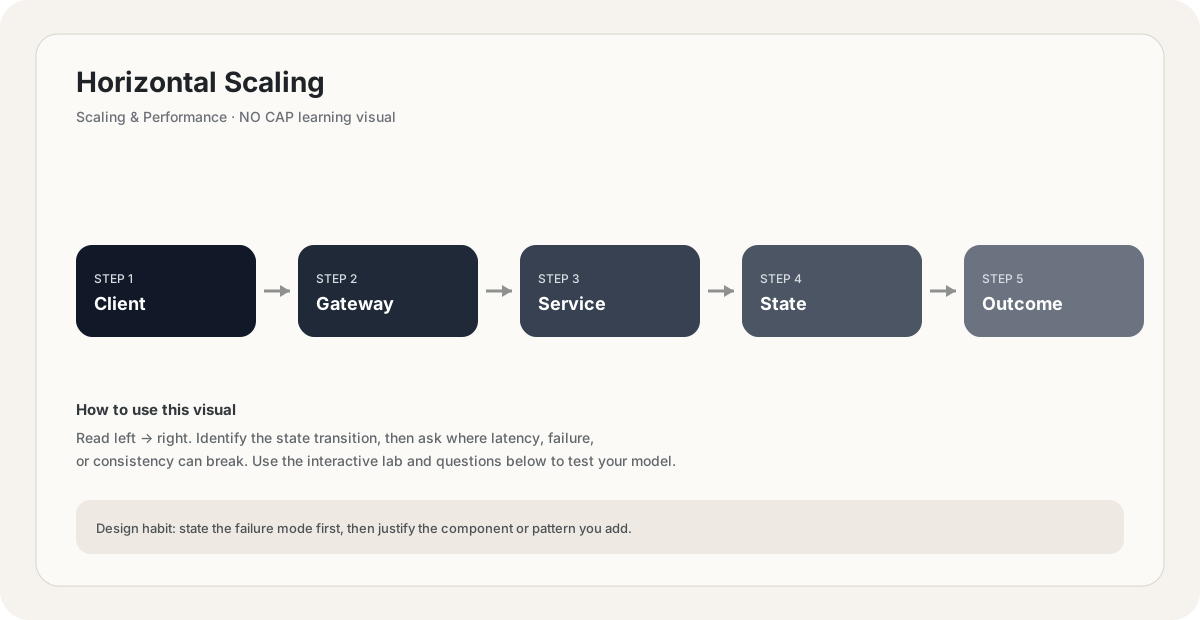
Mental model. Think of Horizontal Scaling as a deliberate boundary in a system. The boundary exists because something becomes harder to manage when everything is done in one place: latency, scale, failure isolation, consistency, cost, or team ownership. The useful question is not “what does Horizontal Scaling mean?” but “what pressure makes this boundary worth introducing, and what new failure mode does it create?”
Before choosing Horizontal Scaling, name the workload, the critical user path, the dominant bottleneck, the failure you are trying to absorb, and the trade-off you are willing to accept. If you cannot name those five things, the design is probably premature.
// Pseudocode
request = receive()
result = horizontal_scaling(request)
return result

// Production questions:
// 1. What happens on timeout?
// 2. Can this operation be retried safely?
// 3. What is the bottleneck?Back-of-the-envelope reasoning
Numerical lens: write down traffic, payload size, read/write ratio, peak multiplier and durability target before choosing a component. The numbers should justify the architecture.
Interactive sandbox: Horizontal Scaling
Scale instances against traffic. Predict when the system tips over for Horizontal Scaling.
Change one variable at a time. Predict the failure mode first, then move the slider and see whether your mental model matches the simplified system response.
If you are stuck on Horizontal Scaling, start by drawing the request path and marking every network hop, stateful component, queue, cache and failure boundary. Then estimate where the system will saturate.
You increase traffic by 10× in a system using Horizontal Scaling. What should you inspect first?
Pick one answer.
Which statement is the safest engineering habit when using Horizontal Scaling?
Pick one answer.
You have dashboards for traffic, latency, errors and saturation. You can change the architecture, but every change has operational cost.
Production scenario: your system uses Horizontal Scaling, traffic suddenly spikes, and p99 latency doubles. What is your first move?
Interview drill
Answer this without notes: When would you choose Horizontal Scaling, and when would you intentionally avoid it? Mention at least one bottleneck it addresses, one failure mode it introduces, and one alternative. Then quantify the workload you are designing for.
A useful engineering lens for Horizontal Scaling: define the problem it solves, the simpler design that fails first, the constraint that forces you to introduce this concept, and the new failure modes the concept creates.
Numerical sanity check
Back-of-the-envelope reasoning beats fake precision. State your traffic, payload, concurrency and growth assumptions explicitly, then calculate enough to know whether the current architecture is orders of magnitude away from the target.
Do not optimize for a memorized definition. Reason from the workload and failure mode.
Imagine the simplest version of a system using Horizontal Scaling. What breaks first as traffic grows by 10×, and what would you change before reaching 100×?
Pick one answer.
What you gain, what you pay
- +No hard ceiling — add more nodes as needed.
- +No downtime to scale — add or remove nodes dynamically.
- +Fault-tolerant — lose a node, traffic shifts to others.
- +Cheaper per unit — commodity hardware beats specialized big-iron.
- −Requires statelessness — significant architecture work.
- −Introduces distributed systems problems — consistency, network partitions, debugging.
- −More moving parts — load balancers, service discovery, distributed monitoring.
- −Network latency — inter-node communication is slower than in-process calls.
How this breaks in production
- Sticky sessions — defeats fault tolerance.
- Stateful services — can't scale without sticky sessions.
- Shared-resource bottleneck — if all nodes hit one database, the DB becomes the ceiling.
- Cascade failures — one slow node causes load balancer to retry on others, overloading them.
Don't fall into these traps
- •Treating 'scalability' as only about app servers — databases and caches must scale too.
- •Forgetting that horizontal scaling requires statelessness from day one.
- •Assuming 'add more servers' fixes everything — it doesn't fix slow code or a single bottleneck.
Real systems using this
How real systems implement this
- Netflix — Hundreds of stateless microservices on AWS EC2, auto-scaled by demand. All state in Cassandra and EVCache. Documented in their tech blog.
- Uber — Stateless services in a service mesh, with state delegated to distributed stores (Cassandra, Schemaless).
Practice saying it out loud
- Q1What does it mean for a service to be 'stateless'? Why does it matter for scaling?
- Q2Vertical vs horizontal scaling — when would you choose each?
- Q3Your app servers scale fine but the database is the bottleneck. What do you do?
Further reading & references
Core explanations are original NO CAP material. External references are provided for deeper study and standards.
What next?
Mark as understood once the mental model clicks.
Next recommended
Vertical Scaling