

Message Queues (Async)
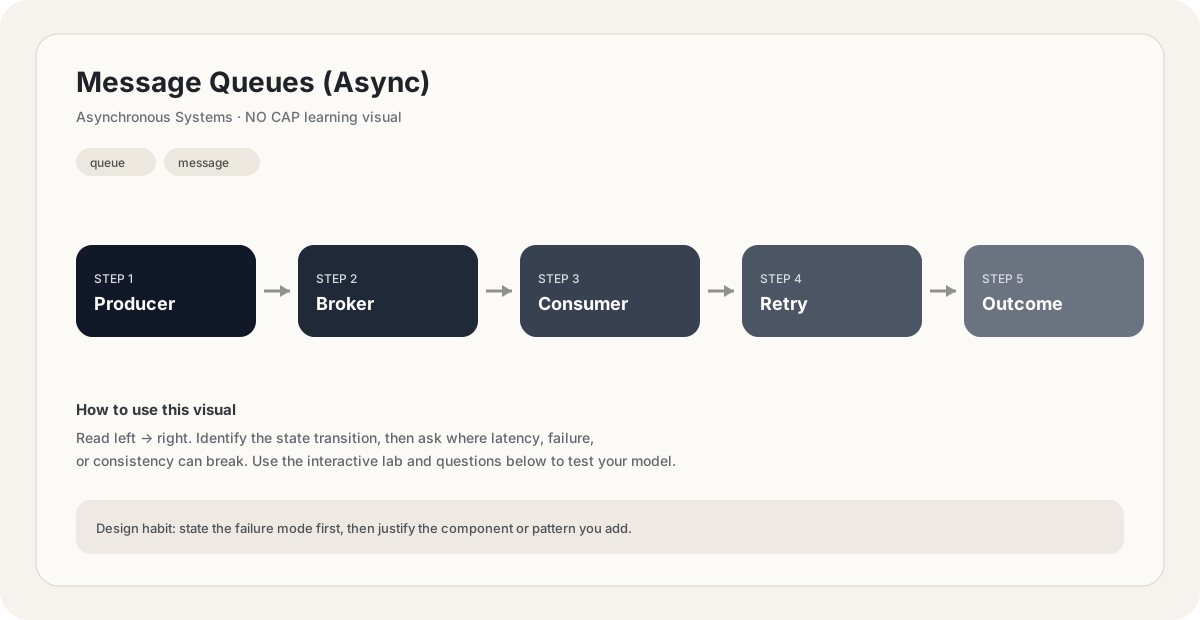
A message queue decouples a producer from a consumer by inserting a durable buffer in between. Producers write messages and immediately return; consumers pull and process at their own pace. This buys you traffic smoothing, producer-consumer independence, retry semantics, and a dead-letter escape hatch for poison messages — at the cost of latency, infrastructure, and the obligation to make every consumer idempotent.
How it works
The foundational message-queues concept introduced the broker as a buffer. This lesson zooms in on what makes a queue actually work in production: the mechanics of at-least-once delivery, visibility timeouts, retry policies, and the dead-letter queue. These are the four knobs an engineer turns when a queue starts misbehaving at 3am.
The mental model is simple but strict: the broker does not know whether your consumer succeeded. All it knows is whether it received an acknowledgement within a timeout. So the broker errs on the side of delivery: if in doubt, redeliver. That single design choice is the source of every gotcha that follows.
At-least-once delivery means a message is never silently lost, but may be delivered more than once. The mechanism is the visibility timeout (AWS SQS) or acknowledgement window (RabbitMQ). When a worker pulls a message, the broker hides it from other workers for a fixed duration. If the worker calls ack() before the timeout, the broker permanently deletes the message. If the worker crashes, hangs, or simply takes too long, the timeout elapses and the message becomes visible again — and is redelivered to a different worker.
This is why every consumer must be idempotent: a charge-card operation keyed on order_id is safe to redeliver because the second delivery hits a uniqueness constraint and no-ops. A charge-card operation with no key double-charges the customer. The idempotency key is usually the message ID itself.
True exactly-once delivery across an asynchronously replicated broker is impossible without distributed consensus on every acknowledgement, which destroys throughput. Every 'exactly-once' feature in the wild (Kafka transactions, SQS FIFO dedup) is at-least-once plus a deduplication step on either the producer or the consumer side.
Dead-letter queues (DLQs) are the safety net for poison messages. A poison message is one that crashes the consumer every time — a malformed payload, an unknown enum value, a reference to a deleted record. Without a DLQ, the message is redelivered forever, eating worker capacity and never succeeding.
The standard policy is max_retries (often 3-5). Each failed attempt increments an attempt counter (stored as a message attribute). When the counter exceeds the threshold, the broker moves the message to a separate DLQ. The DLQ is monitored: a non-empty DLQ pages a human, who inspects the payload, fixes the bug or the data, and replays the message.
The DLQ is the difference between a queue that recovers from a bad deploy and one that loops forever. Every production queue should have a DLQ and an alarm on its depth.
If your worker takes 45 seconds in the p99 case and you set the visibility timeout to 30 seconds, every slow message will be redelivered while the original worker is still grinding through it. You now have two workers processing the same order. Set the timeout to 4-6x your expected processing time, and make sure your consumer is idempotent so even a missed timeout is harmless.
Common async queue patterns:
- Work queue / task queue: one queue, N competing consumers, each message processed by exactly one worker. The bread-and-butter pattern for background jobs.
- Request-response (claim-check): producer enqueues a request with a
reply_toqueue and acorrelation_id; consumer processes and posts the reply to the reply queue. The producer either polls or holds a long-lived connection. - Fan-out via topic: a single message is delivered to multiple subscription queues (see
pub-sub). Use when multiple independent consumers need the same event. - Batching: consumer pulls up to N messages at once, processes them in a single transaction, acks the batch. Latency goes up; throughput goes up dramatically.
- Priority queues: messages carry a priority; broker delivers higher-priority messages first. Use sparingly — most 'priority' workloads are better modeled as two queues.
Your worker takes 60 seconds in the worst case. You set the SQS visibility timeout to 30 seconds. What happens to a worst-case message?
Pick one answer.
A message in your queue fails processing every time it is delivered — it references a user_id that was deleted. What is the correct outcome?
Pick one answer.
Your team claims they need 'exactly-once' delivery from SQS to avoid double-charging customers. What is the right answer?
Pick one answer.
Engineering mental model
Mental model. Think of Message Queues (Async) as a deliberate boundary in a system. The boundary exists because something becomes harder to manage when everything is done in one place: latency, scale, failure isolation, consistency, cost, or team ownership. The useful question is not “what does Message Queues (Async) mean?” but “what pressure makes this boundary worth introducing, and what new failure mode does it create?”
Before choosing Message Queues (Async), name the workload, the critical user path, the dominant bottleneck, the failure you are trying to absorb, and the trade-off you are willing to accept. If you cannot name those five things, the design is probably premature.
message_id = queue.publish({
    "type": "message-queues-async",
    "key": resource_id
})
# Consumer must be safe to retry.Back-of-the-envelope reasoning
Numerical lens: write down traffic, payload size, read/write ratio, peak multiplier and durability target before choosing a component. The numbers should justify the architecture.
Interactive sandbox: Message Queues (Async)
Async messaging decouples producers. Predict retry-storm risk for Message Queues (Async).
Change one variable at a time. Predict the failure mode first, then move the slider and see whether your mental model matches the simplified system response.
If you are stuck on Message Queues (Async), start by drawing the request path and marking every network hop, stateful component, queue, cache and failure boundary. Then estimate where the system will saturate.
You increase traffic by 10× in a system using Message Queues (Async). What should you inspect first?
Pick one answer.
Which statement is the safest engineering habit when using Message Queues (Async)?
Pick one answer.
You have dashboards for traffic, latency, errors and saturation. You can change the architecture, but every change has operational cost.
Production scenario: your system uses Message Queues (Async), traffic suddenly spikes, and p99 latency doubles. What is your first move?
Interview drill
Answer this without notes: When would you choose Message Queues (Async), and when would you intentionally avoid it? Mention at least one bottleneck it addresses, one failure mode it introduces, and one alternative. Then quantify the workload you are designing for.
For Message Queues (Async), separate producer speed from consumer speed. The key design question is what happens when production temporarily exceeds processing capacity: queue it, shed it, slow producers down, or degrade the feature.
Numerical sanity check
A simple queue sanity check: if producers create 8,000 messages/s and consumers process 6,000 messages/s, backlog grows at roughly 2,000 messages/s until the imbalance is corrected.
Do not optimize for a memorized definition. Reason from the workload and failure mode.
A downstream service slows down while Message Queues (Async) keeps accepting traffic. Would you rather apply backpressure, queue more work, shed load, or degrade? Explain the trade-off.
Pick one answer.
What you gain, what you pay
- +Smooths traffic spikes — producers write in 1ms, consumers process at a sustained rate.
- +Decouples producer and consumer lifecycles — they scale, fail, and deploy independently.
- +Durable — messages survive consumer crashes; the broker redelivers.
- +Retries and DLQs give a clean failure model for transient and poison messages.
- +Natural backpressure — queue depth is a load signal you can auto-scale on.
- −Adds latency — the fastest a message can be processed is the time it sits in the queue plus processing.
- −Another moving part — broker must be deployed, monitored, backed up, and sized.
- −Idempotency burden — every consumer must dedupe; nothing in the broker enforces it.
- −Ordering is hard — most brokers only guarantee FIFO within a partition or message group.
- −Operational complexity — visibility timeouts, retry policies, DLQ alarms, replay tooling.
How this breaks in production
- Poison message loops forever — mitigated by max_retries + DLQ + DLQ depth alarm.
- Queue grows unbounded — consumers slower than producers; mitigated by backpressure, autoscaling, or load shedding.
- Visibility timeout too short — duplicate processing of slow messages; mitigated by setting timeout to 4-6x p99 processing time and idempotency.
- Ack lost in flight — broker redelivers; only safe with idempotent consumers.
- DLQ silently fills up — if no alarm, poison messages are quietly lost; mitigated by paging alarm on DLQ depth > 0.
Don't fall into these traps
- •Treating the queue as a database — queues are not queryable, not for long-term storage, and most brokers delete messages after a retention window (SQS: 4 days default, max 14 days).
- •Forgetting to make consumers idempotent — duplicate delivery is normal, not an error.
- •Setting visibility timeout shorter than worst-case processing time — causes duplicate processing.
- •Not monitoring queue depth — a growing queue is the single earliest signal that something is wrong.
- •Ignoring the DLQ — a DLQ with no alarm is a black hole where messages go to die.
- •Using a queue when a synchronous call would do — adds latency and infrastructure for no benefit.
Real systems using this
How real systems implement this
- AWS SQS — Managed at-least-once queue with visibility timeouts, max-receive-count-driven DLQs, and long polling. Standard mode is unordered and best-effort dedup; FIFO mode adds message-group ordering and exactly-once *processing* within a dedup window.
- RabbitMQ — Classic broker with explicit acks, prefetch (QoS) controls per consumer, dead-letter exchanges configured on the queue, and durable queue metadata persisted to disk. Used widely for request-response RPC over reply queues with correlation IDs.
- Sidekiq / Celery / BullMQ — In-process task queues built on Redis. Producer enqueues a job serialized as JSON; workers pop from a Redis list. Retries with exponential backoff, dead job sets, and cron scheduling are first-class.
- Stripe — Stripe's webhook delivery is at-least-once with retries over hours and a dead-letter path for endpoints that never succeed. The idempotency key on Stripe API requests is the same pattern applied to the inbound direction.
Practice saying it out loud
- Q1Walk me through what happens to a message from enqueue to ack. Where can it be lost? Where can it be duplicated?
- Q2How would you design an idempotent consumer? What is the idempotency key, and where do you store the 'already processed' state?
- Q3Your queue depth is growing. How do you diagnose? What do you fix first?
- Q4What is a dead-letter queue, when does a message land in it, and what should an on-call engineer do at 3am?
- Q5Explain why exactly-once delivery is hard. How do real systems approximate it?
Further reading & references
Core explanations are original NO CAP material. External references are provided for deeper study and standards.
What next?
Mark as understood once the mental model clicks.
Next recommended
Event-Driven Architecture