

Queue-Based Load Leveling
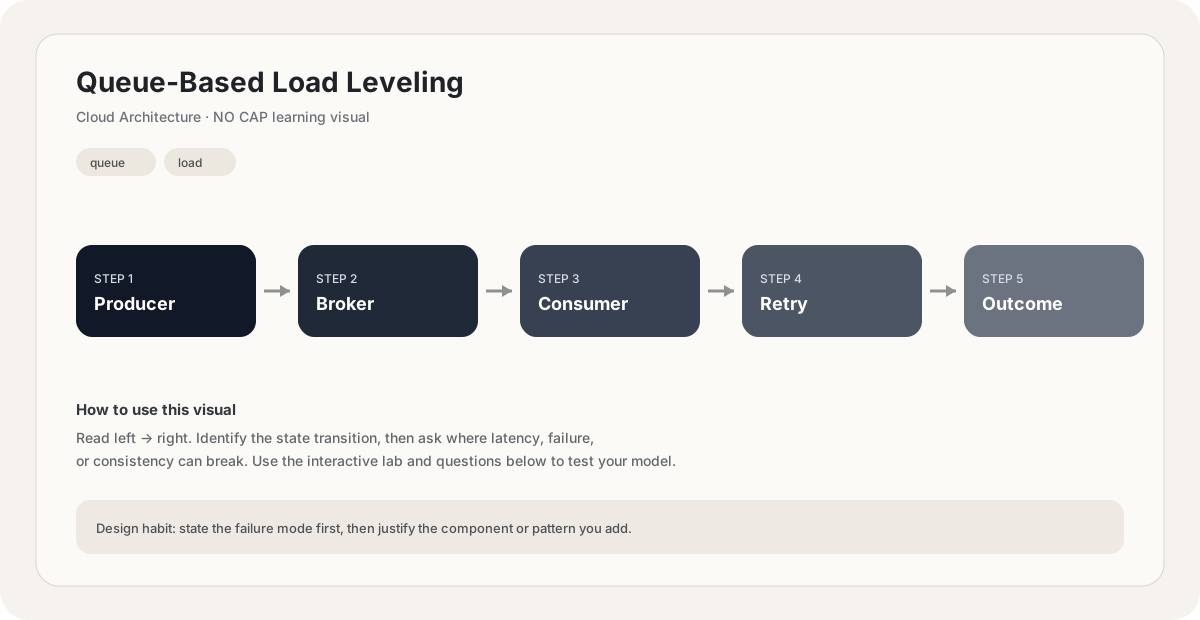
Queue-Based Load Leveling inserts a queue between a task producer and a task consumer to smooth traffic spikes. The producer writes to the queue at whatever rate it receives work; the consumer reads at a steady rate it can sustain. The queue absorbs the difference — bursts fill the queue, lulls drain it — so the consumer never sees the burst and never gets overwhelmed. The result: predictable load on the consumer, no resource over-provisioning for peak, and graceful degradation under sustained overload (queue grows, latency rises, but the system doesn't crash).
How it works
The pattern is simple in concept, powerful in effect:
- The producer receives work (HTTP request, user action, scheduled trigger).
- The producer writes a message describing the work to a queue.
- The producer returns immediately — it doesn't wait for the work to be done.
- The consumer reads messages from the queue at its own pace.
- The queue absorbs the difference between produce rate and consume rate.
The queue acts as a shock absorber. If the producer generates 1,000 tasks/second for 10 seconds (a burst of 10,000 tasks) and the consumer processes 100/second, the queue grows to 9,000 deep at peak, then drains over the next 90 seconds. The consumer never sees the spike — it processes a steady 100/second the whole time.
Key benefits:
- Consumer sized for average, not peak. If average load is 100/sec and peak is 1,000/sec for short bursts, you provision for 100/sec, not 1,000/sec. The queue handles the gap.
- Producer returns fast. No waiting for the work to complete — the API responds in milliseconds, the work happens in the background.
- Decoupled failure modes. If the consumer crashes, the producer still succeeds (messages queue up). If the producer spikes, the consumer still processes steadily.
- Overload is visible, not fatal. Growing queue depth is a signal you can monitor and alert on; cascading failure is opaque.
- Back-pressure via queue depth. If the queue grows too deep, you can shed load, scale consumers, or reject new producers — controlled degradation.
When the queue grows, latency grows too: a task that's 5,000th in queue waits 50 seconds to start (at 100/sec consumer rate). This is the trade-off: load leveling trades latency under load for stability. For latency-sensitive work, you may need priority queues or reject-fast semantics.
Design considerations:
Sizing the consumer pool.
- Provision for average load, not peak — that's the whole point of load leveling. But ensure consumers can drain the queue during lulls so it doesn't grow unbounded.
- For long bursts, autoscale consumers based on queue depth (e.g., scale out when depth > 1000, scale in when depth < 100).
- Beware of consumer startup time — if autoscaling takes 2 minutes to add capacity, the queue may have grown significantly by then. Pre-warm capacity.
Choosing the right queue.
- At-least-once (SQS standard, RabbitMQ) — most common; consumers must be idempotent.
- FIFO (SQS FIFO, Kafka) — if ordering matters; combine with Sequential Convoy for per-key ordering.
- Priority queue — if some tasks are more urgent than others.
- Delayed / scheduled (SQS delay queues, RabbitMQ TTL) — for retries with backoff or scheduled jobs.
Back-pressure and rejection.
- What happens if the queue grows too deep? Options: (a) reject new tasks (return 429/503 to producers); (b) shed load (drop low-priority messages); (c) autoscale consumers harder; (d) accept the latency growth.
- Always set a max queue depth or storage limit. An unbounded queue will eventually OOM the broker or exhaust storage.
Idempotency.
- At-least-once delivery means consumers will see duplicates (during redelivery after crash, consumer rebalance, network issues). Consumers must be idempotent — process each task exactly once semantically, even if the message is delivered multiple times.
- Use deduplication keys, transactional outbox, or idempotent operations.
Visibility and monitoring.
- Queue depth is the key metric — alert on growth, not just current depth. Sustained growth means consumers can't keep up.
- Consumer throughput, error rate, processing latency — standard RED metrics.
- Producer submit rate vs consumer process rate — they should match on average; sustained mismatch indicates overload.
- Per-message age — how long has the oldest message been waiting? Alerts when age exceeds SLA.
Synchronous APIs return the result of the work; asynchronous APIs return a job ID and the client polls for results. Queue-based load leveling pushes toward async: the producer submits work, gets a job ID, and the result is delivered later (via callback, polling, or a different channel). For long-running work (image processing, ML inference, report generation), async is the only option — the connection would time out otherwise. For short, latency-sensitive work, sync may be preferable even under load, accepting occasional overload errors.
When to use Queue-Based Load Leveling:
- Workloads are bursty — short spikes of high volume with idle periods in between.
- Consumer capacity is expensive — databases, third-party APIs with rate limits, GPU-bound processing.
- Producer latency must be low — the producer should respond immediately, not wait for the work.
- Work can be done asynchronously — the user doesn't need the result synchronously.
- You need to absorb producer failures — producer spike shouldn't take down the consumer.
When NOT to use it:
- Latency-sensitive work — if the user is waiting for the result, the queue adds unacceptable latency.
- Strict ordering required across all tasks — FIFO queue serializes everything, killing the load-leveling benefit.
- Workload is steady and predictable — no bursts to absorb; a queue adds indirection without value.
- The producer and consumer have the same capacity — no benefit; the queue is just overhead.
- Tasks are very short (<10ms) — queue overhead exceeds the work.
Common companion patterns:
- Auto-scaling — scale consumers based on queue depth, so a growing queue triggers more capacity.
- Circuit breaker — if a downstream the consumer calls is failing, the consumer breaks and stops, letting the queue absorb.
- Back-pressure — when the queue is full, the producer slows down or rejects new work.
- Priority queue — high-priority tasks jump the queue, low-priority may wait.
- Claim Check — if task payloads are large, store in object storage and pass references.
Your system processes image uploads. Average load is 10/sec, but spikes reach 1,000/sec for short bursts. Without a queue, you provision 1,000/sec capacity. How does Queue-Based Load Leveling change this?
Pick one answer.
Your queue depth has been growing for 30 minutes. Producer rate is steady at 100/sec; consumer rate has dropped to 50/sec. What's happening, and what should you do?
Pick one answer.
Engineering mental model
Mental model. Think of Queue-Based Load Leveling as a deliberate boundary in a system. The boundary exists because something becomes harder to manage when everything is done in one place: latency, scale, failure isolation, consistency, cost, or team ownership. The useful question is not “what does Queue-Based Load Leveling mean?” but “what pressure makes this boundary worth introducing, and what new failure mode does it create?”
Before choosing Queue-Based Load Leveling, name the workload, the critical user path, the dominant bottleneck, the failure you are trying to absorb, and the trade-off you are willing to accept. If you cannot name those five things, the design is probably premature.
message_id = queue.publish({
    "type": "queue-based-load-leveling",
    "key": resource_id
})
# Consumer must be safe to retry.Back-of-the-envelope reasoning
Numerical lens: write down traffic, payload size, read/write ratio, peak multiplier and durability target before choosing a component. The numbers should justify the architecture.
Interactive sandbox: Queue-Based Load Leveling
Queue-based load leveling smooths bursts. Predict queue overflow for Queue-Based Load Leveling.
Change one variable at a time. Predict the failure mode first, then move the slider and see whether your mental model matches the simplified system response.
If you are stuck on Queue-Based Load Leveling, start by drawing the request path and marking every network hop, stateful component, queue, cache and failure boundary. Then estimate where the system will saturate.
You increase traffic by 10× in a system using Queue-Based Load Leveling. What should you inspect first?
Pick one answer.
Which statement is the safest engineering habit when using Queue-Based Load Leveling?
Pick one answer.
You have dashboards for traffic, latency, errors and saturation. You can change the architecture, but every change has operational cost.
Production scenario: your system uses Queue-Based Load Leveling, traffic suddenly spikes, and p99 latency doubles. What is your first move?
Interview drill
Answer this without notes: When would you choose Queue-Based Load Leveling, and when would you intentionally avoid it? Mention at least one bottleneck it addresses, one failure mode it introduces, and one alternative. Then quantify the workload you are designing for.
For Queue-Based Load Leveling, separate producer speed from consumer speed. The key design question is what happens when production temporarily exceeds processing capacity: queue it, shed it, slow producers down, or degrade the feature.
Numerical sanity check
A simple queue sanity check: if producers create 8,000 messages/s and consumers process 6,000 messages/s, backlog grows at roughly 2,000 messages/s until the imbalance is corrected.
Do not optimize for a memorized definition. Reason from the workload and failure mode.
A downstream service slows down while Queue-Based Load Leveling keeps accepting traffic. Would you rather apply backpressure, queue more work, shed load, or degrade? Explain the trade-off.
Pick one answer.
What you gain, what you pay
- +Consumer sees steady load — sized for average, not peak.
- +Producer returns immediately — low latency API responses.
- +Decoupled failure modes — consumer crash doesn't break producer.
- +Overload is visible (queue depth) — monitorable, alertable, debuggable.
- +Graceful degradation under sustained overload — latency grows, system doesn't crash.
- +Composes with autoscaling — scale consumers based on queue depth.
- −Latency grows with queue depth — unsuitable for latency-sensitive work.
- −Operational complexity — now you operate a queue, monitor depth, manage consumer autoscaling.
- −At-least-once delivery — consumers must be idempotent.
- −Ordering is generally FIFO across the queue — combine with Sequential Convoy for per-key ordering.
- −Unbounded queue growth can OOM the broker or exhaust storage — needs limits and back-pressure.
How this breaks in production
- Sustained producer > consumer rate — queue grows unbounded, latency grows without bound.
- Consumer crash — messages queue up but no processing happens; needs autoscaling or alerting.
- Poison message — bad message causes consumer to fail repeatedly; needs dead-letter queue.
- Visibility timeout too short — message redelivered before consumer finishes, causing duplicates.
- Queue broker failure — single point of failure; needs HA broker.
- Hot partition (if partitioned) — one key dominates, that partition's queue grows while others idle.
Don't fall into these traps
- •Not monitoring queue depth — silent growth leads to surprise outages.
- •Not setting a max queue size — unbounded growth can OOM the broker.
- •Consumers not idempotent — at-least-once delivery causes duplicate effects.
- •Sizing consumers for peak anyway — defeats the cost benefit of load leveling.
- •Using a queue for latency-sensitive work — users see unacceptable delays.
- •Not handling consumer crashes — messages pile up while consumer is down; needs autoscaling or alerting.
Real systems using this
How real systems implement this
- AWS SQS + Lambda / ECS consumers — A canonical cloud pattern: producers write to SQS, consumers (Lambda functions or ECS tasks) read at their own pace. SQS absorbs bursts. Lambda's concurrency limits act as a natural consumer capacity cap; queue depth triggers auto-scaling.
- Sidekiq / Celery (Ruby / Python background job systems) — Application-level job queues for background processing. Producers enqueue jobs (Redis-backed); worker processes consume at their own rate. Used for email sends, report generation, image processing — classic load-leveling use cases.
- Kafka as a load-leveling buffer — Kafka topics act as durable, partitioned load-leveling buffers between producers and consumers. Producers write at any rate; consumers in a group read at their own pace. Used at scale by LinkedIn, Netflix, Uber for absorbing traffic spikes.
Practice saying it out loud
- Q1What is Queue-Based Load Leveling, and what problem does it solve?
- Q2Your workload bursts to 100x average for short periods. How does a queue change your capacity planning?
- Q3Your queue depth has been growing for 30 minutes. What's happening, and what do you do?
- Q4When would you NOT use Queue-Based Load Leveling? Give concrete examples.
- Q5How does this pattern compose with autoscaling, circuit breakers, or priority queues?
Further reading & references
Core explanations are original NO CAP material. External references are provided for deeper study and standards.
What next?
Mark as understood once the mental model clicks.
Next recommended
Back Pressure