

Quorum
A quorum is the minimum number of nodes that must participate in an operation for it to be considered valid. The fundamental rule is R + W > N: the read quorum and write quorum must overlap, so any read sees the latest write. For a 5-node cluster, a quorum is 3 — the smallest majority that cannot simultaneously agree on two conflicting values. Quorums are the math behind every consensus protocol, every replicated write, and every dynamic-membership decision; understanding them is the difference between 'it works on my laptop' and 'it survives a partition.'
Foundational.
How it works
A quorum is the minimum set of nodes that must agree for an operation to be safe. The two foundational rules:
- Majority quorum: in a cluster of N nodes, a quorum is
floor(N/2) + 1. For N=3, quorum is 2. For N=5, quorum is 3. For N=7, quorum is 4. Two majorities of the same set must share at least one node — that shared node cannot have voted for two conflicting values, which guarantees safety. - Read-write overlap: for replicated data with N copies, if reads touch R copies and writes touch W copies, then
R + W > Nguarantees any read overlaps with the last write. So at least one node that participated in the write is also consulted by the read — and that node has the latest value.
Quorums are the entire mathematical basis for consensus safety, replicated write durability, and partition-tolerant leader election.
Quorums give you a tunable consistency dial. With N=3 replicas, common settings:
- W=1, R=1: writes ack after one replica, reads consult one replica. Fast but may return stale data; no overlap guarantee. Used for high-throughput, low-criticality data.
- W=QUORUM=2, R=QUORUM=2: writes ack after 2 replicas, reads consult 2. R+W=4 > 3, so reads see the latest write. The default for most strongly consistent settings.
- W=3, R=1: writes ack after all replicas (maximum durability), reads consult 1 (fast reads). R+W=4 > 3, strong consistency. Used for read-heavy workloads where durability is critical.
- W=ALL=3, R=ALL=3: every replica participates. Strongest consistency but slowest; any replica failure blocks the operation.
This is exactly the Dynamo-style tunable consistency used by Cassandra (ONE, QUORUM, LOCAL_QUORUM, ALL, LOCAL_ONE) and DynamoDB (eventually consistent reads vs. strongly consistent reads). Per-request tuning is the key insight: not every operation needs the same guarantees, so the client picks.
Fault tolerance is floor((N-1)/2) failures tolerated. For N=3: tolerate 1. For N=5: tolerate 2. For N=7: tolerate 3. Going from N=3 to N=4 buys nothing — you still tolerate only 1 failure, because a 2/2 partition has no quorum on either side. Going from N=4 to N=5 buys you one more tolerated failure (2 instead of 1). So adding an even node is wasted infrastructure; adding an odd node improves fault tolerance. This is why consensus clusters are 3, 5, or 7 nodes — never 4 or 6.
Variants and refinements:
- Strict quorum: every read sees the latest write (R+W>N). Simple, correct, slow.
- Sloppy quorum: during a partition, writes go to any reachable node (not just the 'home' replicas), with a hint that the value should be forwarded to the home replicas when the partition heals (hinted handoff). Used by Dynamo and Cassandra. Trades strict consistency for availability during partitions.
- Read repair: when a read discovers that replicas have diverged versions, the read response is used to repair the lagging replicas in the background. Combined with anti-entropy (Merkle tree sync), this keeps replicas eventually consistent.
- Sticky quorum / read-your-writes: route reads to the same replicas that handled the prior writes from the same session. Avoids the stale-read-after-write problem without paying for full quorum on every read.
- Quorum cache invalidation: a write notifies a quorum of cache nodes; reads consult a quorum. The overlap ensures no stale cache hit survives a write.
The cost of a quorum is tail latency. A write that requires 3 acks from 5 replicas waits for the 3rd-fastest reply — which is bounded by the slowest of those 3, not the median. Under load, the slowest replica can be 100x slower than the median, so quorum writes have a long tail. Systems mitigate this by:
- Speculative retries: if the quorum is not reached within X ms, send the write to additional replicas in parallel.
- Read-repair on read: instead of waiting for the slowest replica, return the latest value as soon as the read quorum is reached, then repair the lagging replica asynchronously.
- Local quorum: only require quorum within the local datacenter (
LOCAL_QUORUMin Cassandra). Cross-datacenter replication is async, trading strong consistency for low latency.
This is why AP systems like Cassandra and DynamoDB default to LOCAL_ONE or LOCAL_QUORUM: the cost of cross-region quorum is too high for most workloads.
You have a 5-node Cassandra cluster. The client uses consistency LEVEL ONE for writes and LEVEL ONE for reads. What is the implication?
Pick one answer.
Your team decides to expand a 3-node etcd cluster to 4 nodes for 'more redundancy.' What is the problem with this plan?
Pick one answer.
Why does the R+W>N rule guarantee strong consistency, and what does it actually guarantee?
Pick one answer.
Engineering mental model
Mental model. Think of Quorum as a deliberate boundary in a system. The boundary exists because something becomes harder to manage when everything is done in one place: latency, scale, failure isolation, consistency, cost, or team ownership. The useful question is not “what does Quorum mean?” but “what pressure makes this boundary worth introducing, and what new failure mode does it create?”
Before choosing Quorum, name the workload, the critical user path, the dominant bottleneck, the failure you are trying to absorb, and the trade-off you are willing to accept. If you cannot name those five things, the design is probably premature.
// Pseudocode
request = receive()
result = quorum(request)
return result

// Production questions:
// 1. What happens on timeout?
// 2. Can this operation be retried safely?
// 3. What is the bottleneck?Back-of-the-envelope reasoning
Example: with 5 replicas, a majority quorum is 3. Losing 2 replicas still leaves a majority available for a quorum-based protocol.
Interactive sandbox: Quorum
Quorum reads/writes trade latency for consistency. Predict availability for Quorum.
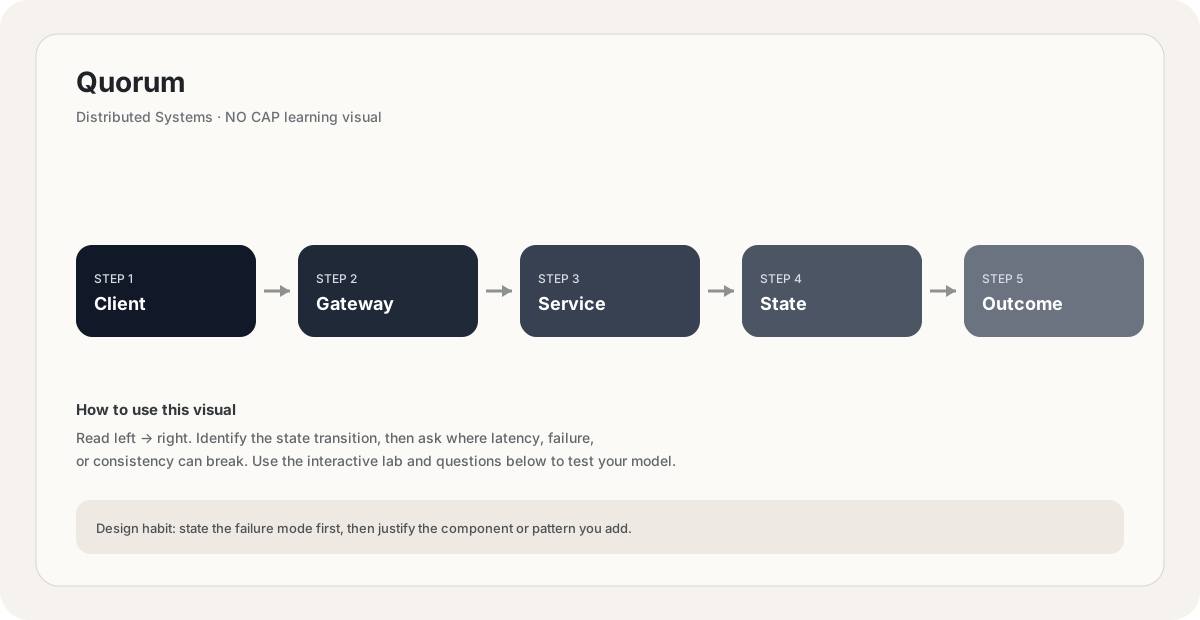
Change one variable at a time. Predict the failure mode first, then move the slider and see whether your mental model matches the simplified system response.
If you are stuck on Quorum, start by drawing the request path and marking every network hop, stateful component, queue, cache and failure boundary. Then estimate where the system will saturate.
You increase traffic by 10× in a system using Quorum. What should you inspect first?
Pick one answer.
Which statement is the safest engineering habit when using Quorum?
Pick one answer.
You have dashboards for traffic, latency, errors and saturation. You can change the architecture, but every change has operational cost.
Production scenario: your system uses Quorum, traffic suddenly spikes, and p99 latency doubles. What is your first move?
Interview drill
Answer this without notes: When would you choose Quorum, and when would you intentionally avoid it? Mention at least one bottleneck it addresses, one failure mode it introduces, and one alternative. Then quantify the workload you are designing for.
A useful engineering lens for Quorum: define the problem it solves, the simpler design that fails first, the constraint that forces you to introduce this concept, and the new failure modes the concept creates.
Numerical sanity check
Back-of-the-envelope reasoning beats fake precision. State your traffic, payload, concurrency and growth assumptions explicitly, then calculate enough to know whether the current architecture is orders of magnitude away from the target.
Do not optimize for a memorized definition. Reason from the workload and failure mode.
Imagine the simplest version of a system using Quorum. What breaks first as traffic grows by 10×, and what would you change before reaching 100×?
Pick one answer.
What you gain, what you pay
- +No single point of failure — quorum tolerates minority node failures.
- +Tunable consistency per request (R and W chosen by the client).
- +Strong consistency achievable (R+W>N) without a centralized leader.
- +Foundation for consensus, leader election, and replicated writes.
- +Prevents split-brain in network partitions — only the majority side can operate.
- −Higher latency than single-node writes — every write waits for the slowest of the quorum.
- −Long tail latency — bounded by the slowest replica in the quorum.
- −Throughput capped by quorum size and replica response time.
- −Even-sized clusters waste resources — 4 nodes tolerate the same as 3.
- −Quorum-based systems block on partition loss (correct but visible as downtime).
How this breaks in production
- Quorum loss during partition — both halves block; mitigated by accepting lower consistency (sloppy quorum) for less critical workloads.
- Stale reads despite quorum — read does not compare versions across replies; mitigated by read-repair and timestamp/version comparison.
- Long-tail latency — slowest replica in quorum bounds latency; mitigated by speculative retries and read-repair-on-read.
- Livelock during reconfiguration — joint consensus required for safe membership change.
- Hot partition in quorum systems — single key cannot exceed quorum throughput; mitigated by partitioning.
Don't fall into these traps
- •Using R=1, W=1 on data that requires strong consistency — no overlap guarantee.
- •Expanding clusters to even sizes — wastes nodes without improving fault tolerance.
- •Assuming R+W>N alone guarantees linearizability — also need version comparison and read repair.
- •Forgetting that LOCAL_QUORUM is not the same as QUORUM — local-only quorum can be stale globally.
- •Setting quorum too high (W=ALL) — any replica failure blocks the entire write.
- •Using quorum where best-effort would do — pays the latency cost for no benefit.
Real systems using this
How real systems implement this
- Apache Cassandra — Tunable per-request consistency: ONE, LOCAL_ONE, QUORUM, LOCAL_QUORUM, ALL. Writes are replicated to N nodes (replication factor); client chooses how many must ack. Read repair fixes lagging replicas in the background.
- Amazon DynamoDB — Eventually consistent reads (default) are cheaper and faster; strongly consistent reads (consistent_read=true) require quorum. Replication factor is 3 across AZs; the choice is per-request.
- etcd (Raft) — Majority quorum required to commit every write. 3-node cluster tolerates 1 failure; 5-node tolerates 2. Quorum is the safety mechanism — split-brain is impossible because two partitions cannot both have majority.
- Riak — Dynamo-derived KV store with N=3 by default, R=2, W=2 (quorum). Sloppy quorum during partitions with hinted handoff; read-repair on read divergence. Bucket-level tunable consistency.
Practice saying it out loud
- Q1Explain the R+W>N rule. Why does it guarantee strong consistency? What else do you need?
- Q2Why are consensus clusters always odd-sized? What is wrong with a 4-node cluster?
- Q3Walk through the trade-offs of W=1 vs W=QUORUM vs W=ALL. When do you choose each?
- Q4What is sloppy quorum, and what consistency trade-off does it make?
- Q5Your Cassandra cluster has 5 nodes. Client uses ONE for writes and QUORUM for reads. Is this strongly consistent?
Further reading & references
Core explanations are original NO CAP material. External references are provided for deeper study and standards.
What next?
Mark as understood once the mental model clicks.
Next recommended
Consensus (Paxos / Raft)